

Hi there, I’m Eric.
If you’re anything like me, you’ve probably spent a fair amount of time standing in front of a store shelf, looking at a "leather" bag or a wallet, and wondering why one costs twenty bucks while another costs a hundred. It’s tempting to grab the cheaper one, right? We’ve all been there. But I’ve spent a lot of my life working with my hands, and if there’s one thing I’ve learned at The Kilted Leatherworker, it’s that the "bargain" usually ends up being the most expensive thing you’ll ever buy.
As we look ahead at the next ten years of our lives, I want to talk about the difference between things that are built to be thrown away and things that are built to be loved. We’re living in a world of fast fashion, where items are designed to trend for a month and fall apart in six. But there is another way: a slower, more honest way.
Let’s dig into why handmade leather goods are the better bet for your next decade.
The Ghost in the Machine: What "Fast Fashion" Really Is
I remember the first time I bought a "genuine leather" belt from a big-box retailer. It looked great for about three weeks. Then, something weird happened. The "leather" started peeling off in thin, plastic-like strips, revealing a grey, cardboard-like fuzz underneath. Little did I know at the time, I wasn't buying a piece of hide; I was buying a sandwich of chemicals, glue, and leather scraps pressed together.
That is the essence of fast fashion. It’s built on the idea of "planned obsolescence." The goal isn't to make you a happy customer for life; the goal is to make you a customer again next year when the first item breaks.
When you buy a mass-produced leather tote bag from a fast-fashion giant, you aren't paying for quality craftsmanship. You’re paying for the marketing, the massive retail space, and the shipping containers. The actual material? It’s often the lowest grade possible, coated in a thick layer of plastic (polyurethane) to make it look uniform.
In ten years, that fast-fashion bag will likely be sitting in a landfill, still not fully decomposed because of all that plastic coating. Meanwhile, a real, handmade piece is just getting its second wind.
Honest Materials and the Power of the Stitch
When I sit down at my workbench to start a new project, I’m looking at a side of leather that has character. It has marks, it has a history, and it has a smell that you just can't fake. I use honest materials because I want you to feel the weight of quality every time you pick up your gear.
Take a look at the way things are put together. In the fast-fashion world, everything is sewn by machines at lightning speed. If one thread snaps, the whole seam unzips like a cheap jacket.
In my shop, I prefer a different approach. I focus on durability, ensuring that every stitch is perfect. When I make a minimalist wallet, I'm thinking about the fact that you're going to pull that out of your pocket thousands of times over the next decade. It needs to hold up.

Look at that stitching. It’s thick, it’s deliberate, and it’s meant to stay put. That’s the difference between something made by a machine in a factory and something made by a person who cares about the final result.
The 10-Year Math: Why "Expensive" is Actually Cheaper
I get it: dropping a chunk of change on a rustic tote feels like a lot upfront. But let’s do some quick "Eric-math" (which is mostly just common sense and a bit of reflection).
If you buy a $40 "leather-style" tote bag every year because the handles rip or the lining shreds, you’ve spent $400 over a decade. And for those ten years, you’ve spent a lot of time carrying a bag that looks kind of... sad.
Now, if you invest in one of our handmade leather goods, like a solid leather tote or a leather belt, you pay more today, but you’re done for the decade. In fact, you might be done for the rest of your life. That bag won't just "last": it will actually get better. It develops a patina, which is a fancy way of saying it absorbs the oils from your hands and the sunlight from your travels, turning into a rich, dark, unique version of itself.
You aren't just buying a container for your stuff; you're buying a companion for your adventures.

Protecting Your Thoughts: The Case for a Leather Journal Cover
In our digital age, there is something incredibly grounding about putting pen to paper. I love the feeling of opening a fresh notebook. But those paper covers? They get dog-eared and ripped within a month of being tossed in a bag.
This is where a leather journal cover comes in. It’s a shield for your ideas. Whether you’re using a handcrafted leather journal cover for your big dreams or a mini leather journal cover for your daily to-do lists, the leather acts as a protector.
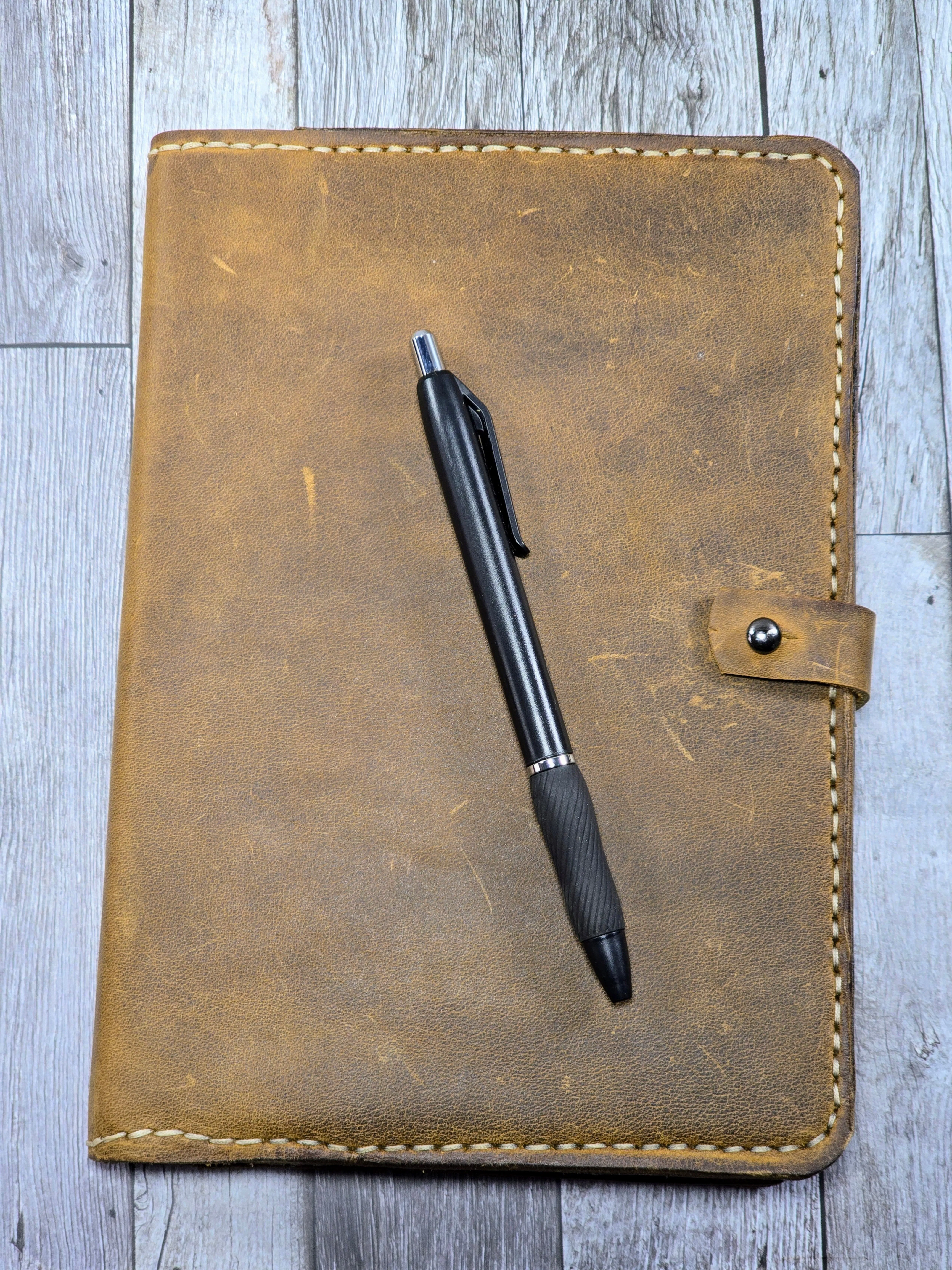
As you can see, these aren't just covers; they're heirlooms in the making. Imagine pulling this out of your bag ten years from now. The leather will be softer, the tan will be deeper, and every scratch on the surface will remind you of a place you’ve been or a thought you’ve had. That’s not something you get from a plastic-wrapped planner from the grocery store.
Sustainability: Small Scale vs. Global Waste
I try to be humble about my impact, but I do think it’s important to mention that buying handmade is just better for the planet. Fast fashion is one of the world's biggest polluters. The "use it and lose it" mentality creates mountains of waste.
When I work on a piece, I’m creating it one step at a time. I use every bit of the hide that I can. There’s no massive factory chimney billowing smoke here: just me, a few tools, and a lot of patience. By choosing to "buy for life," you are effectively opting out of the waste cycle. You’re choosing quality over quantity, and that’s a choice that pays dividends for the environment over the next ten years.
Whether it's a leather shaving kit for your travels or a clutch wallet for a night out, these pieces are designed to stay out of the trash and in your hands.
Items That Are Unconditionally Loved
There’s a word I like to use when describing my work: honest.
When you buy a mass-produced item, there is no soul in it. It was made by a machine, boxed by a machine, and sold by a corporation. But when you buy from a small shop like mine, you’re getting a piece of my journey. You’re getting the hours I spent ensuring the edges were smooth and the snap was secure.
I enjoy the process of making things that people will truly love. There is something about the weight of a well-made belt pouch or the snap of a burgundy wrinkle minimalist wallet that just feels right.

When you own something that is handmade, you tend to take better care of it. You might condition the leather once a year. You might wipe it down after a rainy day. That relationship with your belongings is part of what makes life feel a little more intentional and a little less chaotic.
Which Will You Choose for Your Next Decade?
So, as you look forward to the next ten years: the jobs you'll hold, the trips you'll take, and the memories you'll write down: ask yourself what kind of gear you want by your side.
Do you want something that will be falling apart by next Christmas? Or do you want a leather journal cover that will hold your life's story, or a leather tote bag that will carry everything you need from now until 2036?
I know my choice. I’ve built my life around the idea that things should be made well, made honestly, and made to last.
Thank you so much for taking the time to read this and for supporting small-scale craftsmanship. It really means the world to me that I get to spend my days making things that might end up being a part of your story. If you ever have questions about how to care for your leather or which piece might be right for you, don’t hesitate to reach out.
I’m always here to help you find that piece you’ll love for the next decade and beyond.
Stay kilted,
Eric
Founder, The Kilted Leatherworker LLC