

Good morning! I’m Eric, and if you’ve been following along with The Kilted Leatherworker LLC for a while, you know I’m usually knee-deep in hides, thread, and the occasional cloud of sawdust. Today, I wanted to pull back the curtain a little bit.
When you see a finished handmade leather wallet or a rugged leather belt pouch on my table at a local market, it looks polished, sturdy, and ready for an adventure. But the journey from a raw hide to that final product is a wild ride. It’s a mix of meticulous science, old-world tradition, and, if I’m being honest, a healthy dose of chaos.
I’ve just added some new "behind the scenes" photos to the site, and looking at them made me realize just how much goes into this craft before a single stitch is even placed. So, grab a coffee, and let’s talk about what it actually takes to bring these goods to life.
It Starts With the Material (and a bit of Science)
Before a piece of leather ever touches my workbench, it has already been through an incredible transformation. I often get asked why I choose certain hides or why some leather feels "alive" compared to the stuff you find in big-box stores.
The journey actually begins with three big stages: preparation, tanning, and crusting. Most of the leather I use comes from cattle, which is a byproduct of the meat industry. Little did I know when I first started out just how complex the "beamhouse" process is, cleaning, soaking, liming, and pickling the hides just to get them ready for tanning.

I love the tanning stage especially, because that’s where the magic happens. Whether it's vegetable tanning (using bark and plant extracts) or chrome tanning, this is what preserves the hide and keeps it from decomposing. But for me, the real character comes out during "crusting." This is when the leather is dyed, fatliquored (to make it soft and water-resistant), and dried.
When I’m selecting hides for a leather belt or a new batch of minimalist wallets, I’m looking for that perfect balance of strength and suppleness. I want something that will age with you, picking up a patina that tells your story.
Embracing the Chaos of the Workbench
Now, let’s talk about my favorite part: the mess.
If you walked into my shop on a Tuesday afternoon, you might be a little overwhelmed. There are spools of waxed thread everywhere, jars of adhesives, masking tape, specialty hardware, and more tools than I can count. I call it "organized chaos," though my family might emphasize the "chaos" part more than the "organized" part!

There’s something about a busy workbench that I find incredibly relaxing. It’s where the "craft" really takes over. Every handmade leather goods item I produce starts with a template and a sharp blade. There’s no room for error here. If my hand slips while cutting the flap for a leather belt pouch, that piece of leather is done.
I take my time with every step, ensuring that every edge is burnished and every corner is rounded just right. There’s a certain rhythm to it, the sound of the mallet, the pull of the thread, the smell of the leather and the adhesives. It’s a sensory experience that I never get tired of.
The Art of the Stitch
If there is one thing that defines a piece from The Kilted Leatherworker, it’s the hand-stitching. While machines are great for speed, I truly believe nothing beats the durability of a hand-sewn saddle stitch.
When I’m working on a leather sporran or a tooled belt pouch, I’m using two needles and a single piece of thread. This means if one stitch ever happens to break (which is rare!), the whole thing won’t unravel like a machine-sewn seam would. It takes longer, sometimes a lot longer, but ensuring that every stitch is perfect is how I guarantee these pieces will last a lifetime.
I love working on sporrans in particular. They are such a unique blend of history and utility. Whether it’s a traditional Jacobite style or something more modern with a tartan liner, there’s a lot of pride that goes into making sure they hang just right on a kilt.

The Market Day "Tetris"
After days (or weeks) of stitching, dyeing, and finishing, the products are finally ready. But the job isn't done yet. Bringing products to market involves a whole different kind of skill: Car Tetris.
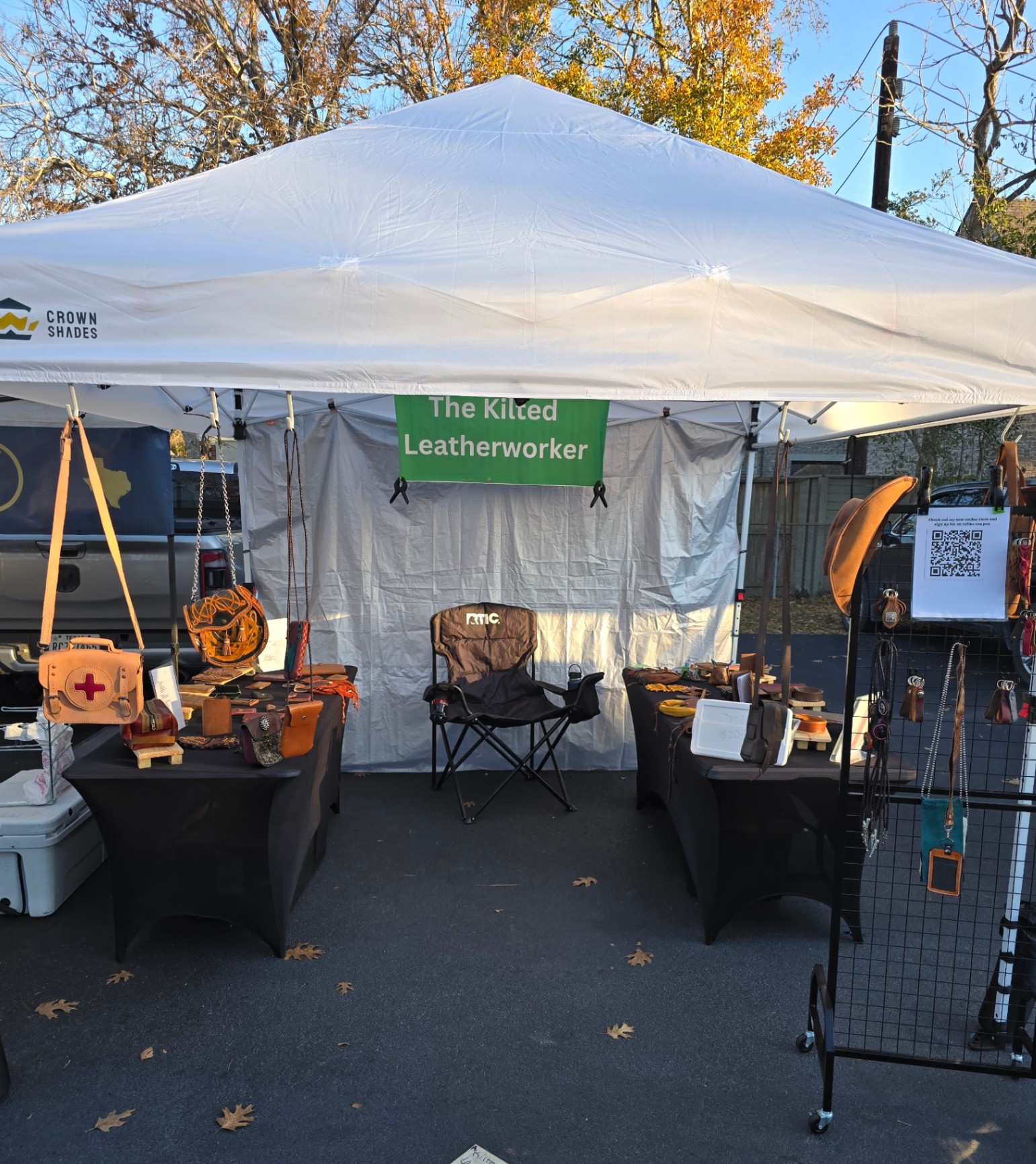
Every market morning starts way too early. I’m usually out in the driveway while the sun is still thinking about coming up, trying to fit a 10x10 tent, tables, displays, and crates of handmade leather goods into my car.

As you may have guessed, it’s a tight fit. It’s a puzzle that requires patience and a bit of luck. (And maybe a little bit of caffeine!) But there’s a sense of excitement in that early morning hustle. I’m thinking about who I might meet that day, which handmade leather wallet will find a new home, and which stories I’ll get to hear from people stopping by the booth.
Why I Do What I Do
When I finally get the market booth set up and the first customer walks up, all the "chaos" of the workshop and the "hustle" of the morning fades away.
I love seeing people’s faces when they pick up a three-pen loop journal cover or run their hands over a rustic tote. There is something about the weight and the texture of real leather that connects people to the craft.
As a maker, my goal is to create items that aren't just "accessories," but companions for your daily life. Whether it’s a snap key strap that you use every single morning or a leather sporran you wear for special family gatherings, I want you to feel the care that went into every step of its creation.
Thank You for Being Part of the Journey
I realized early on that I couldn't do this without you. Every time you leave a comment, share a post, or buy a piece of my work, you’re supporting a dream that started with a single piece of leather and a very messy workbench.
There is a lot of noise in the world today, and things are often made to be thrown away. I’m committed to doing the opposite, making things "one step at a time" that are built to endure.
Thank you for taking the time to read about what goes on behind the scenes here at The Kilted Leatherworker LLC. It’s a journey full of character, a bit of sawdust, and a whole lot of heart. I’m so grateful you’re a part of it!
If you’re ever at a local market, please come by and say hi. I’d love to show you the "craft" in person (and maybe even show you some photos of the "chaos").
Warmly,
Eric
Founder and Owner, The Kilted Leatherworker LLC